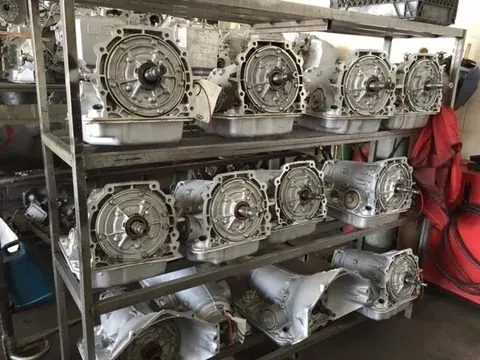
The transfer case sits behind the transmission, often with a driveshaft running forward and another running back. On most trucks, SUVs and Jeeps it is the part that makes the vehicle four-wheel drive, and it has its own fluid, its own seals and its own wear.
At a glance
- It feeds power to both axles
- Low range multiplies torque for slow, steep or heavy work
- Gear-driven and chain-driven designs both exist
- It needs its own fluid and attention
What does a transfer case do?
It is an intermediate gearbox. Power comes in from the transmission output and leaves toward the axles. In vehicles with a selectable system it can send power to the rear only, or to both ends. It also lets the front and rear wheels turn at slightly different speeds in normal road use in the designs that include a center differential, which prevents the binding drivers call driveline windup. Where this one sits in the drivetrain is easiest to see on the 4x4 and four-wheel drive page.
How is one built?
Engineering references describe two main styles. Gear-driven cases use sets of gears. They are strong and heavy, and are found mostly in large trucks. Chain-driven cases use a chain, usually to power one axle; they are quieter and lighter, which suits many Jeeps, SUVs and pickups. A case may bolt directly to the transmission, called married, or sit farther back and connect with a short shaft, called divorced.
What is low range?
Many transfer cases include a set of low-range gears. Low range lets the vehicle move slowly while the engine stays in its working range, and it multiplies the torque at the axles. That suits steep, rough or heavy-load driving. Low range is often missing from all-wheel-drive cars. On a selectable 4WD, shifting into low range usually requires stopping and putting the transmission into neutral, as the owner's manual will describe.

What are the warning signs?
- A grinding, whining or clunking sound that changes with speed or when 4WD is engaged
- A 4WD selector that will not move, or an instrument panel light that blinks and does not complete the shift
- A leak at the front or rear seal where the driveshafts connect
- A vibration under the vehicle that was not there before
- Binding or hopping in tight turns on dry pavement while in four-wheel drive
These are covered on the 4WD noise or not engaging page. The shop works on transfer cases; the transfer case repair page has the details.
How do I look after one?
Follow the fluid interval in the owner's manual, which is separate from the transmission's. Use 4WD as the manual describes, and avoid dry pavement in a part-time system that has no center differential. Ask about the fluid when your vehicle is up on a lift for other work. Compare how yours is set up in the 4WD versus AWD guide.